Arts & Culture
A Golden Age of Creativity
The Regency period produced some of the finest literature, architecture, and artistic achievements in British history.
Literature & the Novel
Few periods in British cultural history match the Regency for sheer literary brilliance. It was an era in which the novel came of age — not merely as entertainment, but as a serious art form capable of exploring the deepest questions of society, morality, and individual identity. At the centre of that transformation stood Jane Austen.
Austen published all six of her major novels between 1811 and 1817: Sense and Sensibility, Pride and Prejudice, Mansfield Park, Emma, Northanger Abbey, and Persuasion. Her genius lay in her precision — a few sentences of dialogue could expose an entire character. She wrote without sentimentality about marriage, money, class, and the limited choices available to women, doing it with an irony so fine that readers still debate where it begins and ends.
While Austen mapped the drawing rooms of England, the Romantic poets were tearing the roof off. Lord Byron was the era's great celebrity — his Childe Harold's Pilgrimage (1812) made him famous overnight and he became the prototype of the Romantic hero: brooding, brilliant, and scandalous. He died at 36 fighting for Greek independence, and became immortal.
Percy Bysshe Shelley brought revolutionary politics and philosophical idealism to poetry. His Ozymandias — published in 1818 — remains among the most powerful works in the English language. John Keats wrote almost all of his greatest poetry in a single extraordinary year, 1819, before dying of tuberculosis in Rome at twenty-five.
Beyond poetry, the era gave birth to Gothic fiction as a serious literary form. Mary Shelley's Frankenstein (1818), written when she was barely nineteen, invented an entirely new genre. Sir Walter Scott dominated the historical novel — his Waverley series outsold everyone and created a fashion for romanticised history across Europe.
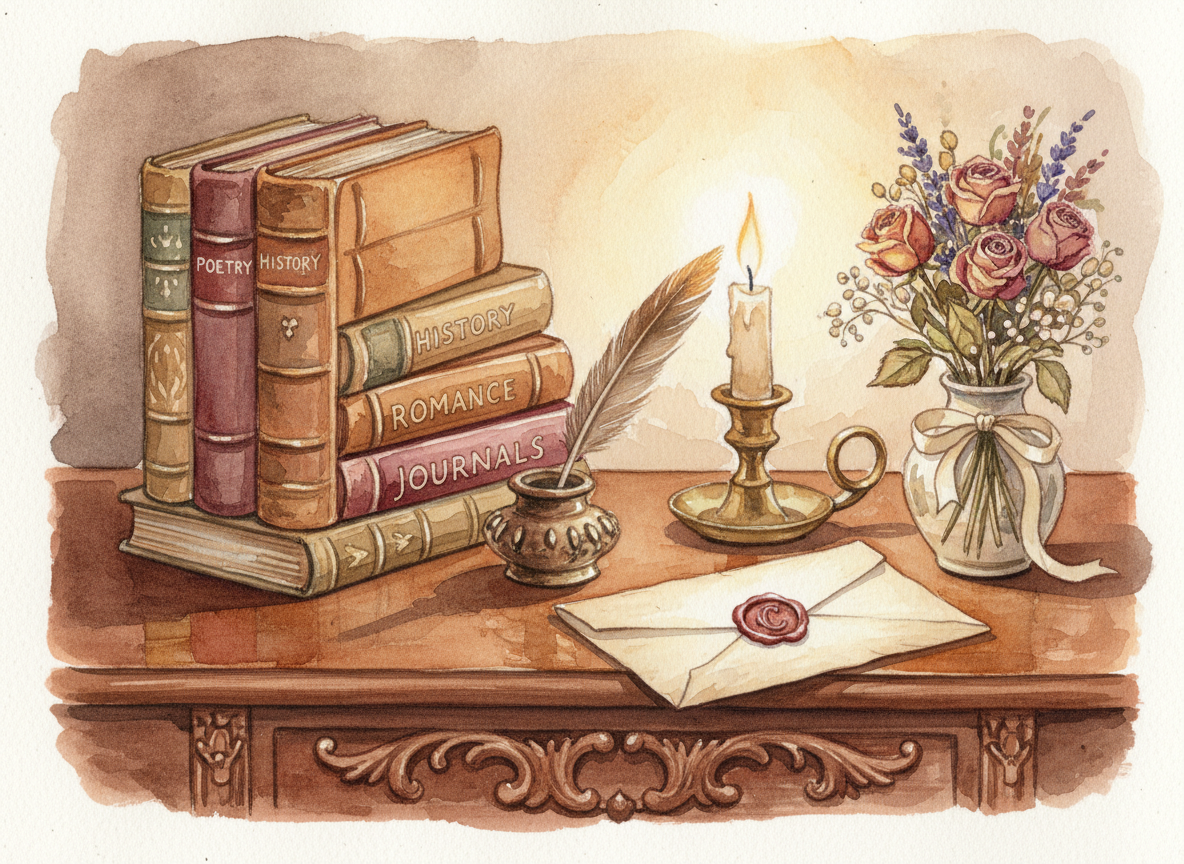
Literacy was rising, circulating libraries made books accessible to the middle classes, and periodicals like Blackwood's Magazine created a culture of literary debate. Reading aloud in the evenings was a cherished domestic ritual.
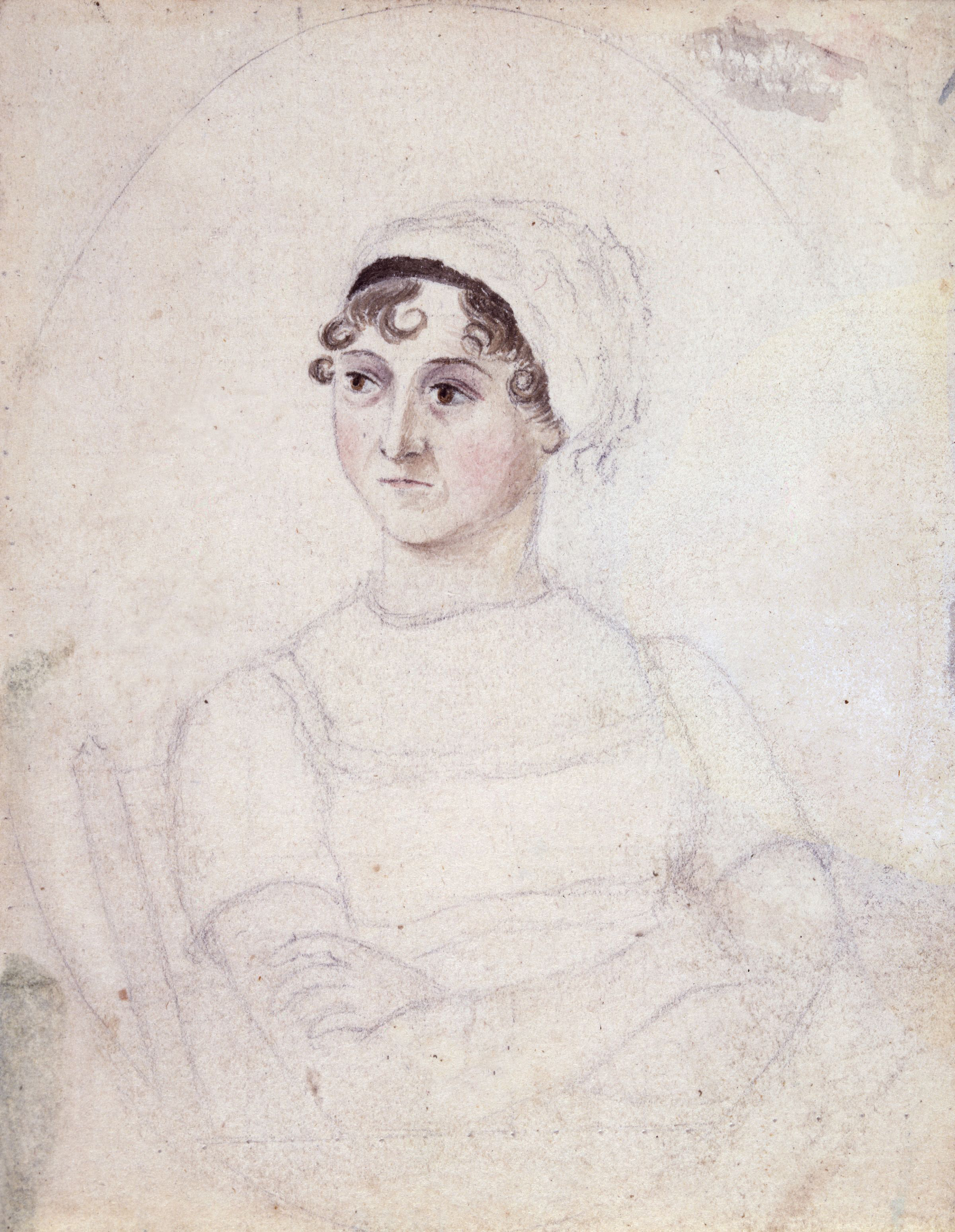
Jane Austen, c. 1810
Architecture & Design
If the Regency produced a golden age of literature, it equally produced one of architecture. The built environment of England was transformed during this period, shaped by royal ambition, new wealth, and a passion for the classical past.
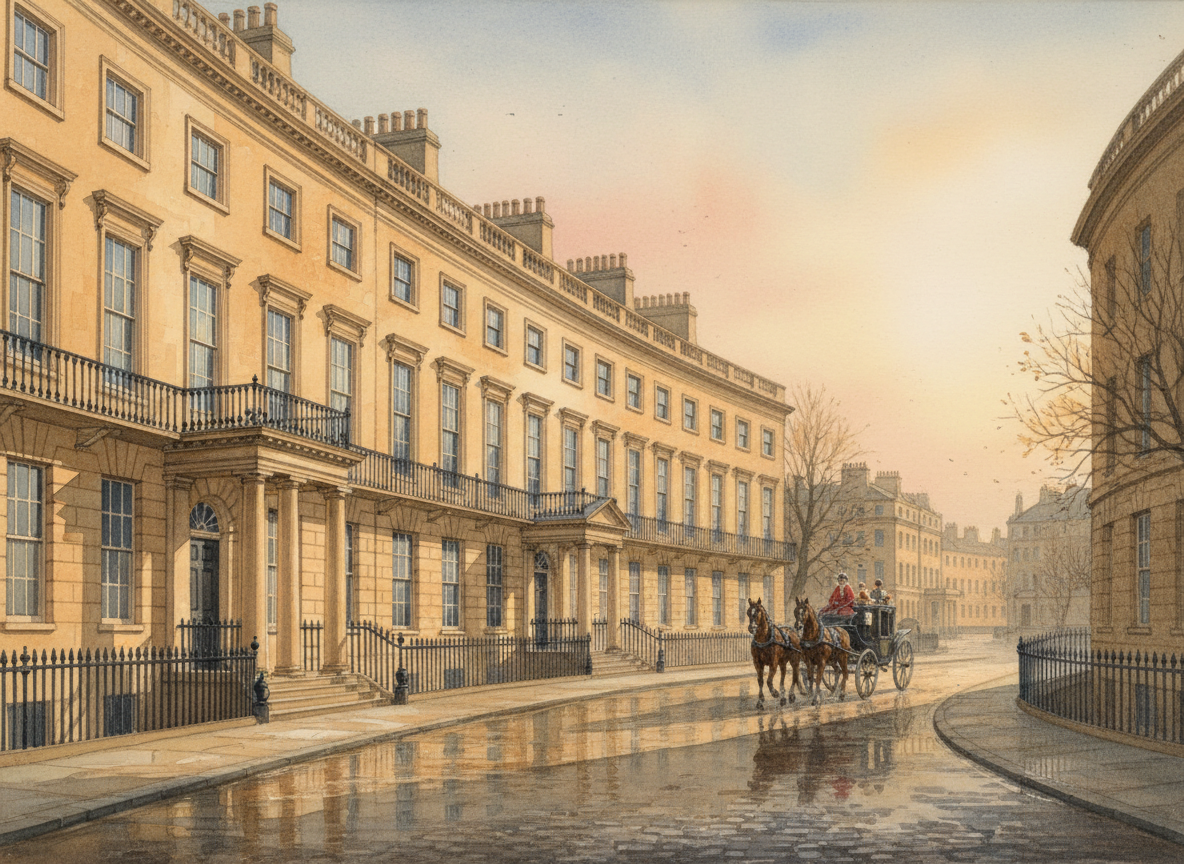
The dominant figure was John Nash, whose vision for London under the patronage of the Prince Regent remade the capital. His grand scheme connected Carlton House to the newly laid-out Regent's Park via the sweeping curve of Regent Street — a processional route lined with stucco-fronted terraces. The cream-coloured Nash terraces that border Regent's Park remain among the finest examples of urban planning in Europe.
For the Prince Regent's private pleasure, Nash produced something altogether more fantastical. The Royal Pavilion at Brighton (completed 1823) drew on Mughal Indian architecture for its exterior — onion domes, minarets, and latticed stonework — while the interiors blended Chinese chinoiserie with almost hallucinatory opulence.
Bath reached the height of its social life during the Regency. The Royal Crescent, The Circus, and the Pump Room — all in honey-coloured Bath stone — formed the backdrop to the social rituals Austen described so precisely. Bath was where one went to be seen, to take the waters, and to find a husband or wife.
Interior design followed the same Neoclassical principles, drawing inspiration from ancient Greece and Rome. Furniture by Thomas Hope featured Grecian couch forms, Egyptian motifs, and brass inlays on dark rosewood and mahogany. Rooms were pale — cream, stone grey, soft green — with delicate plasterwork friezes.
The Regency style was, at its best, an expression of confidence: the confidence of an empire that had defeated Napoleon and believed its taste was the finest the world had produced. In its architecture, as in its literature, it left a mark that has never faded.
The Cultural Spaces of Regency London
Art, commerce, and society intersected in a network of galleries, auction rooms, print shops, and pleasure gardens that made London the cultural capital of the era.
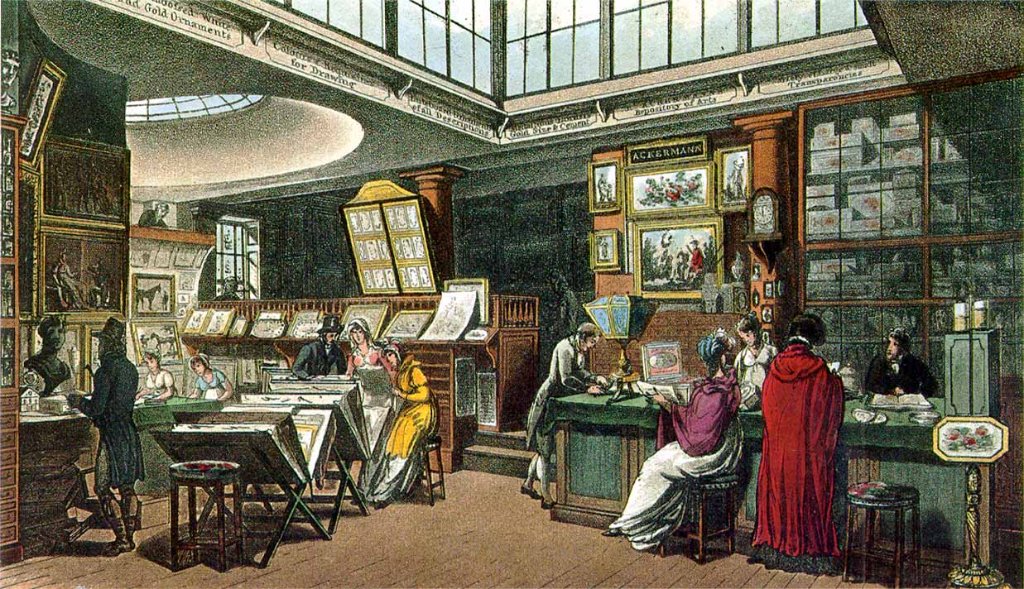
Ackermann's Repository of Arts
Rudolph Ackermann's famous shop on the Strand — part gallery, part print shop, part cultural hub. Publisher of the era's most celebrated fashion plates.
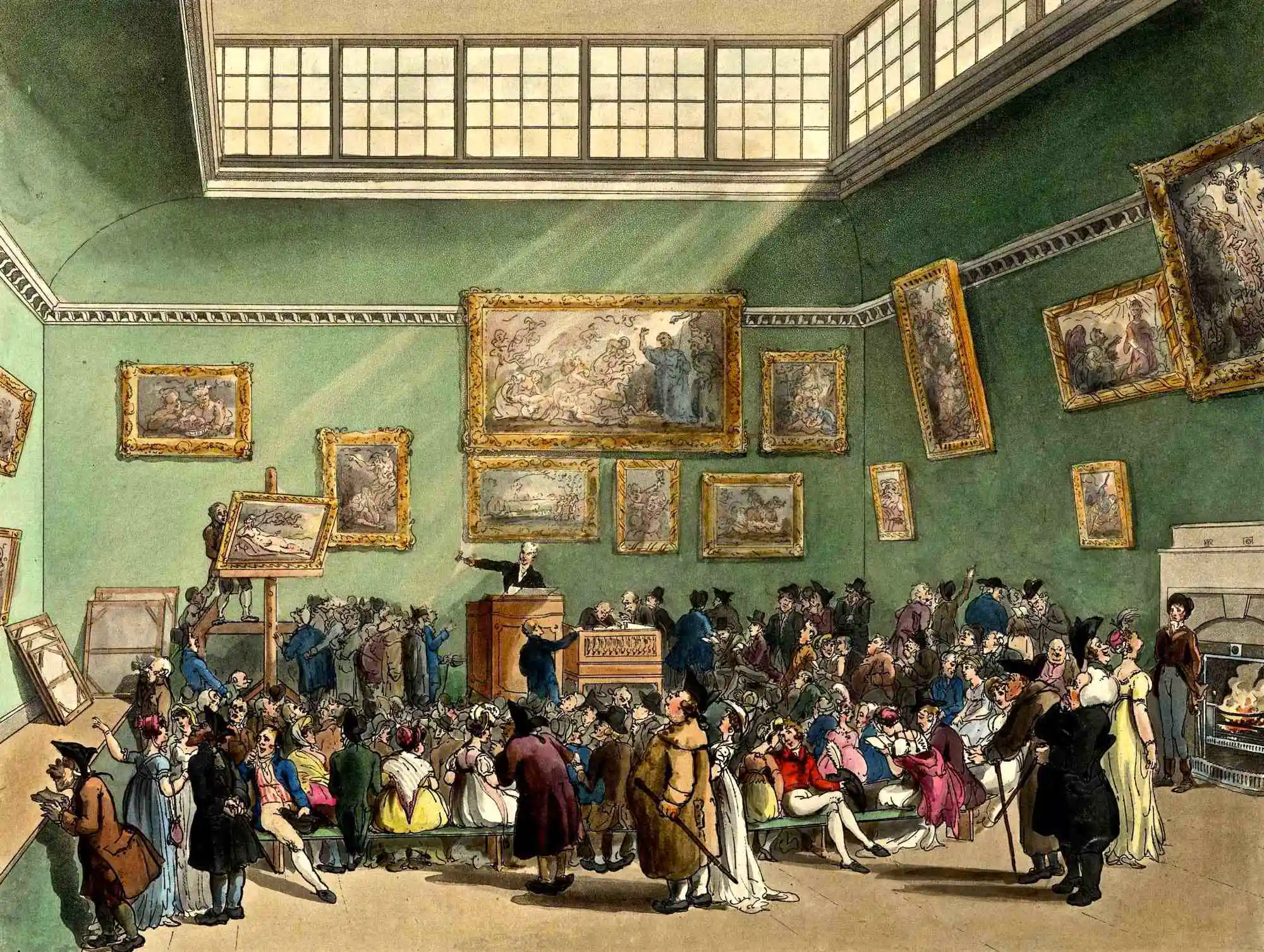
Christie's Auction Room
Christie's Great Room, King Street — where the finest collections changed hands, and the social event of the art calendar attracted the highest society.
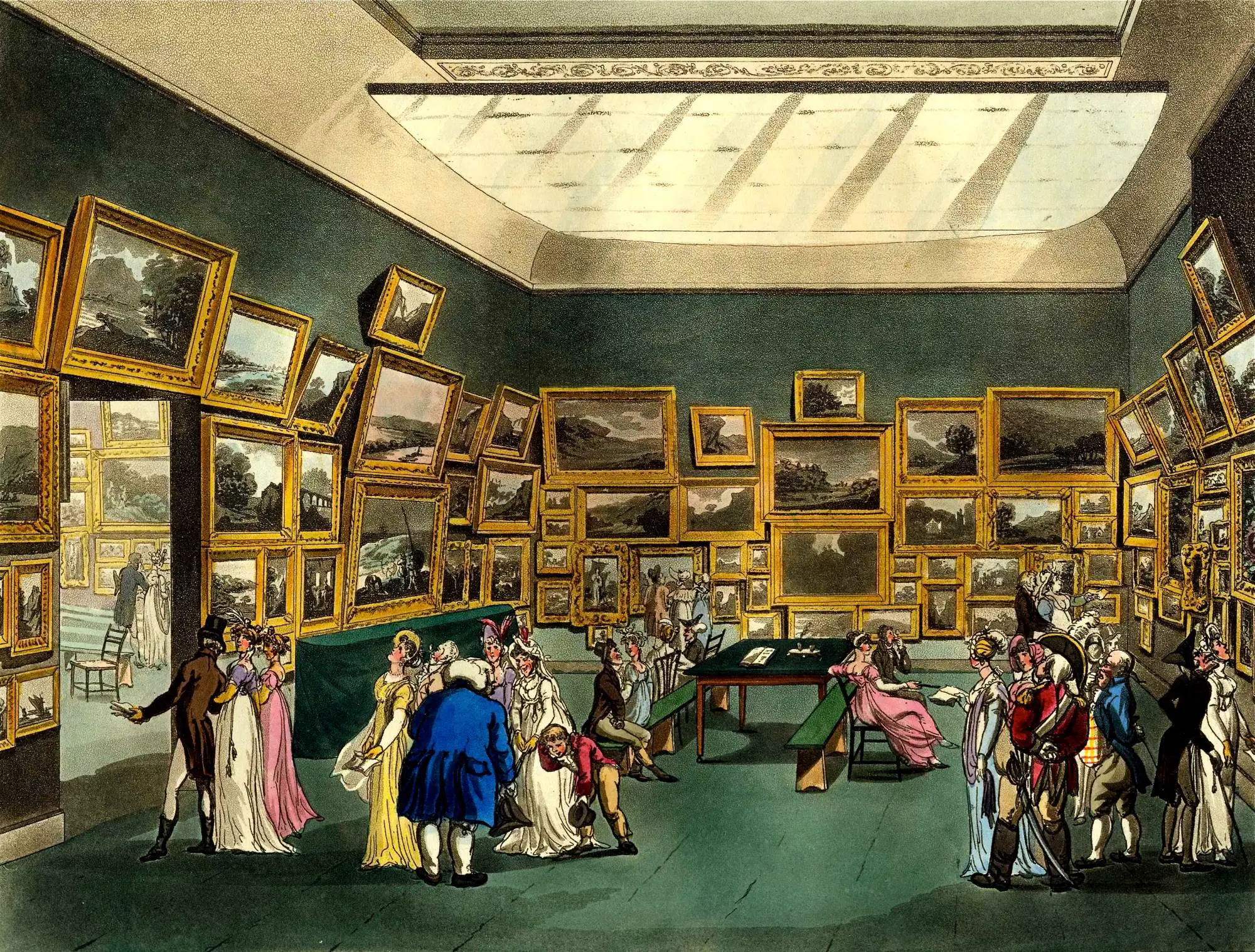
Exhibition of Water-Coloured Drawings
Old Bond Street exhibition — watercolour painting flourished in the Regency period as both a polite accomplishment and a serious art form.
Somerset House
Home of the Royal Academy of Arts — the annual Summer Exhibition was the most important event in the London art calendar, drawing thousands of visitors.
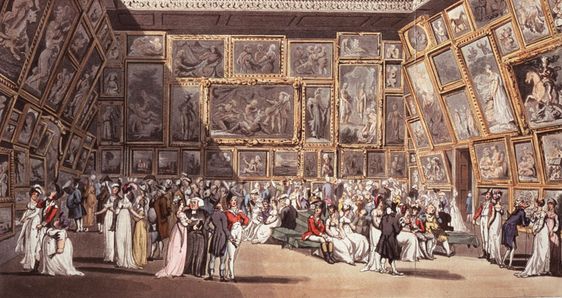
Royal Academy Exhibition
The crowded walls of the Royal Academy's annual exhibition — pictures hung 'salon style' from floor to ceiling, with the most coveted spots at eye level.

Tom & Jerry at the Royal Academy
Cruikshank's satire of the annual exhibition — where fashionable society came as much to be seen as to see the paintings.
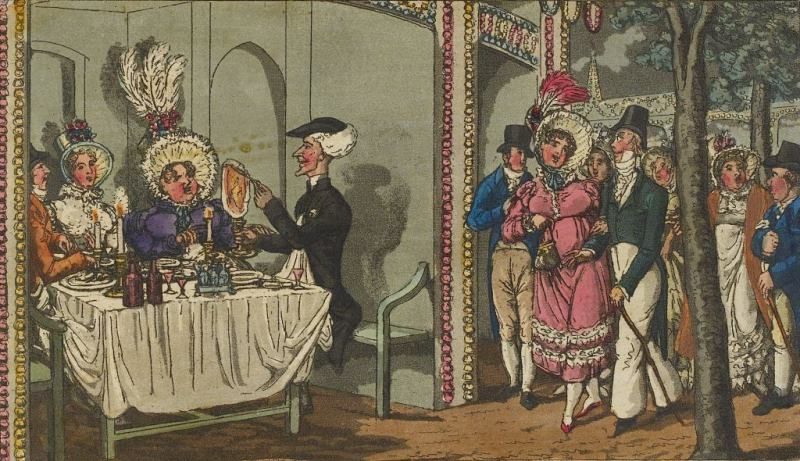
Vauxhall Gardens, 1820
Vauxhall Pleasure Gardens — the great democratic space of Regency leisure, open to all who could pay the entrance fee, with music, fireworks, and supper boxes.
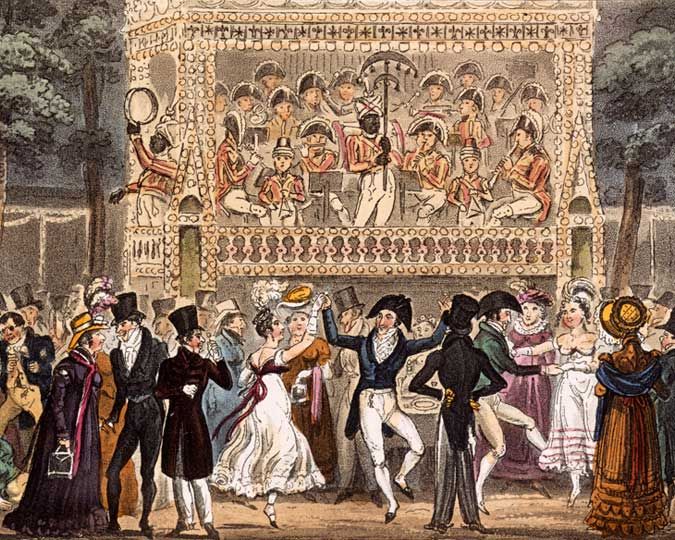
Circulating Library
The circulating library — where subscribers paid to borrow novels. The lifeblood of Regency reading culture and the distribution network for Austen's novels.
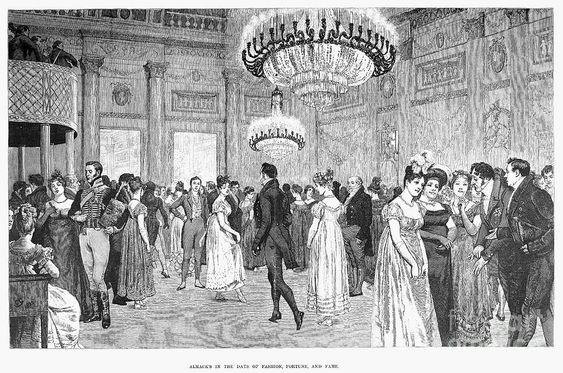
Covent Garden Theatre
Covent Garden Theatre — the theatre was the Regency's great shared entertainment, staging everything from Shakespeare to farce and Italian opera.
Must-Read Authors
- Jane Austen — Pride and Prejudice, Emma
- Lord Byron — Don Juan, Childe Harold's Pilgrimage
- Percy Shelley — Ozymandias, Prometheus Unbound
- John Keats — Ode to a Nightingale, Ode to Autumn
- Mary Shelley — Frankenstein
- Sir Walter Scott — Ivanhoe, Waverley
Iconic Buildings
- The Royal Pavilion, Brighton
- Royal Crescent, Bath
- Regent's Park Terraces, London
- Carlton House, London
- The Assembly Rooms, Bath
- Chatsworth House (Pemberley inspiration)

